Have you ever felt like you needed a vacation to get your energy levels back up right after the holidays? We have. It is, in fact, an extremely relatable feeling. After summer is done and the suitcase is unpacked, it is easy to take one look at your inbox and succumb to the post-summer blues, and therefore find every aspect of work somehow more tiring than it has any right to be. This is also the time of year when most of us tend to forget everything we promised ourselves about slowing down. Work picks up faster than we remembered, and the idea of taking a break during the day starts to feel like a luxury, like somehow we don't deserve it, because we took a few weeks off in August. This we have just described is no less than the perfect recipe for autumn burnout.
Part of our work consists in building unforgettable corporate events, so we notice this pattern every single year. Teams come back from the holidays glowing, energised, full of good intentions and then, a few weeks later, half of them look (and, most importantly, feel) like they never left their desks. The question we asked ourselves therefore had to be not only "how do we patch this up with a nice mid-month incentive trip?" but also "how do we help our clients stop this from happening altogether?"
Beware of the productivity trap
There's a stubborn belief floating around most offices: the more hours spent glued to a screen, the more gets done. The funny thing is, we know by now this is not remotely the case: both empiric experience and academic research back it up, and yet we keep falling back into this trap, because it makes for a tidy narrative. Productivity, however, is the result of multiple factors occurring at once: it requires focus, energy, and the ability to actually think clearly, none of which survive eight uninterrupted hours of screen glare. A short walk, five minutes of silence, a live conversation with another human, or even a few minutes to sit back, close your eyes and listen to a full song without doing anything else can do more for output than another coffee-fuelled sprint through emails at the end of your working day. Businesses, after all, run on people, and people need proper pauses to function well.
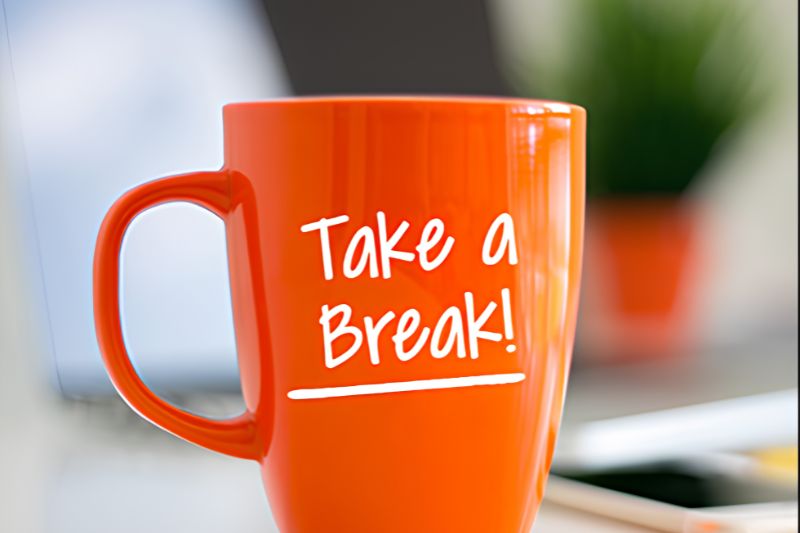
Take a break: it's for science
Did we just say that there is research backing this up? Yes, we did, and yes, there is. Harvard Business Review published an in-depth analysis of this phenomenon by Chris Bailey. The article digs into the mechanisms of burnout and, crucially, the warning signs we tend to brush off until it's too late. Bailey worked with researcher Christina Maslach, exploring the causes and manifestations of chronic stress at work, and succeeding in defining six aspects that we should be monitoring carefully: workload, values, reward, control, fairness and community. As most actual research, these don't sound dramatic at all. They are not buzzwords and they are not necessarily at the top of anyone's mind on an average working day, and yet, if several drift out of balance at the same time, people tend to experience exhaustion, they yield to forms of cynicism and also report a creeping sense of inefficacy in their professional endeavours. The article treats burnout as an everyday risk worth watching, offering a nudge to notice smaller signals before stress becomes the default setting.
How do you switch off, take a break and avoid burnout?
We do talk about this a lot, as a team, both for ourselves and for our clients, and we hear the same advice everywhere: "Remember to take a break." Obvious, and also easier said than done. Have you noticed how stepping away from work, nowadays, usually means stepping straight into something else? When email notifications stops, your own social media notifications kick in, then comes the doom-scrolling, and finally the ever present low hum of FOMO, which makes the very idea of disconnecting sound impossible. Have we given a definitive answer to the question of how to avoid burnout? Absolutely not. In fact, we don't believe in one correct method of doing that, but we are willing to share what we do, as a team. Individually, we are as diverse as any group: a brisk walk works wonders for some colleagues, five quiet minutes with a coffee does the job for others, and that's absolutely fine too. What matters is remembering, every so often, to actually breathe, whatever form that pause happens to take.

Team building and incentive travel as proper breaks
And then there is what we actually do for our clients: team building and incentive travel, which are our core business, exist precisely to force a change of scene and engage with the rest of your team. Milan gives us extraordinary settings to work with, from rooftop terraces to historic courtyards, and we've watched countless corporate groups arrive drained and leave with a new spring in their step. A well-designed day away from your usual professional setting works as a tool for wellbeing, retention and, ultimately, productivity. Businesses that invest in this understand that rested teams build better work, are more competitive and stay focused and committed for longer.