Corporate development strategies increasingly recognise that traditional training formats yield diminishing returns and professional services firms and international enterprises now seek alternatives that deliver measurable improvements in team cohesion through culinary team building experiences whilst offering substantive cultural value.
Culinary team building in Milan represents a sophisticated response to this requirement. Unlike conventional programmes, it demands genuine collaboration under time constraints, develops communication protocols organically, and produces tangible outcomes. The professional kitchen operates according to principles that translate directly to corporate environments: precision, coordination, accountability.
When executive development meets culinary discipline
Corporate gatherings needn't default to endless presentations. Cooking team building experiences in Milan restructure team dynamics through shared technical challenges, creating professional bonds that extend beyond typical workshop formats. A kitchen can provide the perfect environment in which to neutralise hierarchical barriers. Senior executives face identical technical challenges as junior staff: here, performance depends entirely on skill acquisition and collaborative efficiency.
Milan stands as Italy's business capital, generating approximately 20% of national GDP. Simultaneously, the city maintains exceptional gastronomic standards spanning traditional Lombard cuisine to contemporary innovation, thus providing a combination that makes it particularly suitable for programmes targeting international clients who require both operational efficiency and authentic Italian food culture. Participants encounter cuisine rooted in specific regional traditions rather than generic tourist experiences.
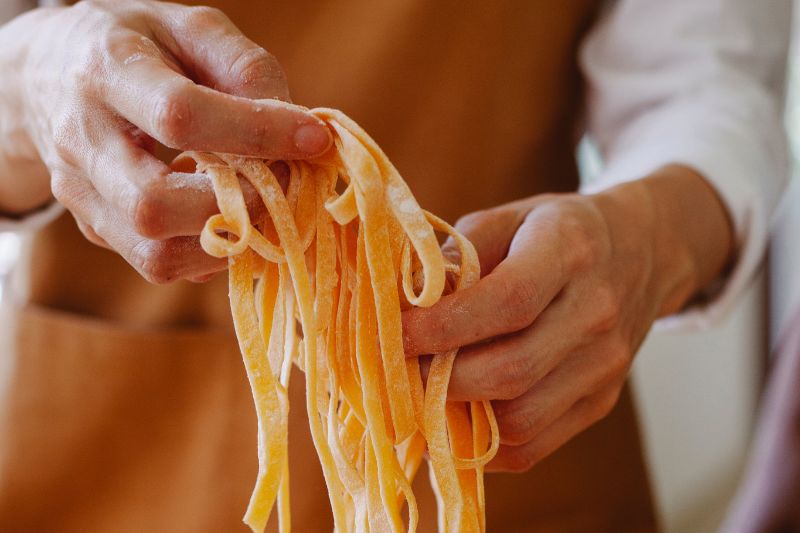
Consider conventional team building formats. Trust exercises that produce minimal lasting impact. Workshop sessions that rarely translate to improved workplace performance. Compare this to structured culinary programmes: teams executing ossobuco preparation, coordinating timing sequences, responding to technical challenges as reduction consistency changes. Kitchen-based team building events develop communication protocols, leadership capacity and analytical problem-solving whilst producing demonstrable results.
Cookery team building in Milan: the treat your team deserves
Milan's suitability extends beyond geographical convenience: the city is a hub of innovation that managed to keep in touch with its tradition, brimful of Italian character, but also crisply efficient, up to the highest standards of any European capital. Milan has undergone substantial urban development, transitioning from purely financial operations into a diversified cultural destination that maintains rigorous professional standards. The city's culinary institutions operate fully equipped professional venues for corporate team building staffed by professionals experienced in corporate contexts, which means they combine serious training environments where technical precision matters and methodology receives appropriate emphasis with engaging interactions that your team will genuinely cherish.
For international delegations particularly, Milan provides context beyond novelty. The risotto techniques being taught originated in this region. Saffron comes from Lombardy cultivation. Each preparation method connects to documented culinary history. Corporate clients participate in established cultural practices rather than manufactured tourist activities.
Programme structures for professional outcomes
Cooking team building adapts to varied organisational requirements and Milan venues, experienced in corporate delivery, offer distinct formats tailored to specific development objectives. From the Total Menu format, assigning each team the responsibility to cook a complete course within a multi-course meal, to our Mystery Box challenges (a format popularised by multiple TV shows), which reward rapid adaptation and blue-sky thinking, these activities test creative problem-solving under constraint, mirroring corporate scenarios where resources arrive unexpectedly and solutions must emerge quickly. Performance becomes immediately quantifiable through peer and expert evaluation, much like it does in corporate life. In some cases, bespoke formats such as the corporate cocktail challenge team building further refine collaboration and timing under pressure.

Operational considerations
Effective culinary team building extends beyond kitchen activity. Shared meals following collaborative preparation serve distinct purposes in team development, as conversation patterns differ when participants consume food they have collectively produced.
Milan's infrastructure is perfectly suited to support your corporate needs: the city provides accessible international connections and maintains numerous venues for team building events in Milan equipped for group activities, transportation systems function reliably, accommodation ranges from established luxury properties to contemporary business hotels, and operational logistics proceed smoothly, allowing focus on programme objectives rather than coordination challenges.
The urban environment itself enhances programme value. Between sessions, participants may access cultural assets including Leonardo's Last Supper, the Galleria Vittorio Emanuele II, or simply observe the city's integration of fashion, commerce and culinary tradition.
Sustained outcomes
Traditional team building programmes produce transient effects. Retention rates for standard workshop content remain demonstrably low. Technical culinary skills, however, establish lasting knowledge: understanding proper vegetable sauté technique or flavour development principles persists beyond the immediate experience and food creates stronger memory anchors than abstract exercises. Teams usually retain specific problem-solving instances: salvaging emulsions under time pressure, achieving precise consistency in temperature-sensitive preparations. These become reference points within team culture and operational vocabulary.
For organisations introducing international clients to Italian business culture, culinary team building in Italy offers substantial engagement through authentic cultural practice. This represents relationship development through shared technical achievement rather than superficial social exercises.
Strategic implementation
Milan maintains ready capacity for corporate culinary programmes. Professional facilities operate year-round. Experienced culinary professionals prepare appropriate curricula. Organisations may continue with conventional formats and accept their documented limitations, or adopt programmes with demonstrated retention and engagement advantages.

Effective team development need not announce itself explicitly. Superior programmes feel like skill acquisition, collaborative problem-solving, and shared achievement. They involve working alongside colleagues on technical challenges, creating results from raw materials, then evaluating collective outcomes.
Sophisticated corporate strategy sometimes requires reconsidering fundamental assumptions about professional development. Milan facilitates this reconsideration with technical rigour, cultural substance and appropriate institutional infrastructure.
Corporate programmes require results. Culinary team building events in Milan deliver them.